Storm and Sunshine
Radical change to deliver a smaller, better civil service
By Danny Kruger MP
• 15th December 2025
Key Takeaways
- Whitehall is bloated - and civil servants are miserable
- We will cut Whitehall down to size - and make it a better, more rewarding place to work
- We will save £5.2 billion per year (£4.16 billion in immediate savings from averted salary costs, plus £1.04 billion in averted pension liabilities for future taxpayers) by cutting FTE headcount by 13%
- We will improve career progression and link pay to performance, with a new £500 million bonus pool
- We invite former and serving officials to help us crack the Whitehall productivity challenge
Introduction
Britain is in crisis: economically, socially, and in terms of our security. All these challenges require an effective government to cut through bureaucratic inertia and execute big decisions to liberate growth, strengthen communities and defend the country.
On 28 October I set out the core principle for the operation of a Reform government. Under Nigel Farage, the administrative state - the permanent civil service - will serve the elected government. This means restoring the actual, not simply formal, responsibility of ministers for policy and delivery.
Reform is considering in detail the operation of the Civil Service and Ministerial Codes, the processes of appointing and removing senior civil servants, the proper degree of political instruction to civil servants, and the best way of organising the centre of government to give effect to the wishes of the Prime Minister.
Alongside this essential work we are committed to getting the size and cost of government under control. Ministers cannot effectively function with a bloated, top-heavy bureaucracy. To be better, government needs to be smaller.
There are three ways to reduce the size and cost of government: 1) to cut out government waste; 2) to improve government productivity, including through the ambitious use of AI; and 3) for government to do less and the private sector and civil society to do more. We need to do all these things, but today I am focusing on the first one: to cut waste.
Let me set the scene first. Someone once said a ‘hard rain’ was coming to Whitehall. I agree that we need some serious weather. As detailed below, the civil service is bloated and costly; ineffective; and in places ideologically hostile to what a Reform government will want to do.1 It will take radical action to change this. But beyond the storm is sunshine: a better, more rewarding place to work for the civil servants who genuinely want to serve the public, and fulfil the manifesto commitments of the elected government.
Civil Service bloat
In October I explained that Reform will ‘make Whitehall Whitehall again’: we will move the civil service out of its glass and steel towers dotted around Westminster and put them back in the official buildings at the heart of government, in the street called Whitehall. I said this would be made possible by substantial reductions in the civil service headcount. Today I can give more detail on these numbers.
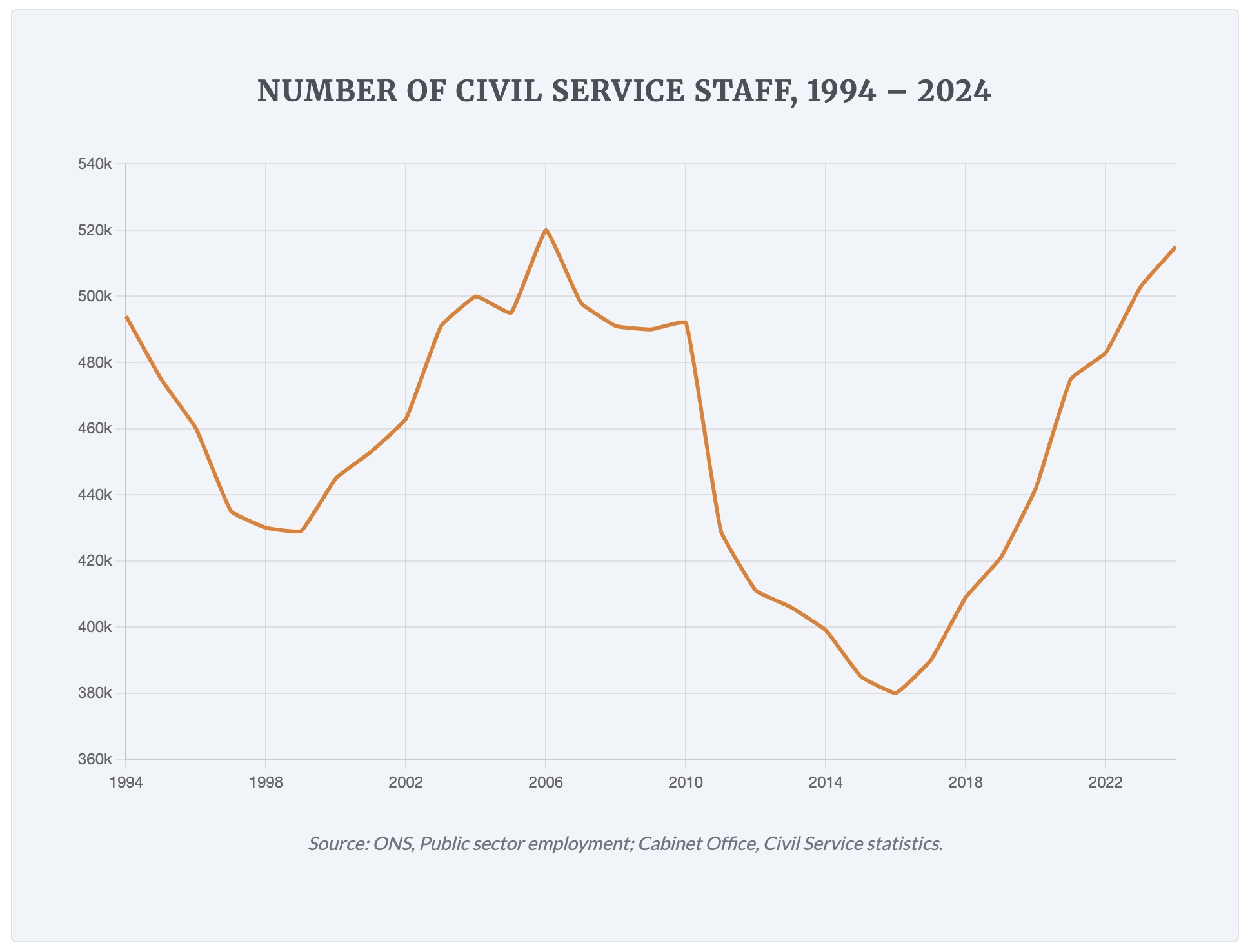
The civil service today employs over 500,000 people. This is the same level as the previous peak at the end of Tony Blair’s government in 2006. Numbers fell significantly after the Global Financial Crisis when Britain was running a 10% budget deficit, but by 2024 we were back to the half-million mark.
Number of Civil Service Staff, 1994 – 2024
Source: ONS, Public sector employment; Cabinet Office, Civil Service statistics.
It is noteworthy that the national civil service has managed to recover completely from the so-called ‘austerity’ years, whereas the local government workforce is down a third since 2010, at what the Office for National Statistics describes as a ‘record low’.2
The reasons for the growth at the national level include both structural factors (i.e. decisions made by governments to organise the civil service in a particular way) and chronic factors (i.e. ways of working by the civil service).
1 See here a discussion of how the civil service could ‘restrain’ a ‘populist’ government. https://open.substack.com/pub/ukcivilservant/p/could-the-civil-service-restrain
Structural factors include the duplication of corporate functions like finance, commercial and HR in both departments and in the Cabinet Office; the establishment of taskforces, particularly in the Cabinet Office, which outlive their tasks; and the growth in the workforce thought to be needed to take on former EU responsibilities, which turned out to be greatly exaggerated (e.g. the judgement of HMRC that it needed 4000 new staff to handle an additional 199 million customs declarations a year after Brexit; in the event less than 40 million new declarations were made, but the funding has not been rescinded, nor customs staff cut).3
Chronic factors include the massive expansion in the ‘policy profession’, which has doubled since 2016 - the ratio of central policy leads to frontline staff has increased between 2 and 6 fold in different operational areas; grade increases, by which the civil service creates new layers of management in the hierarchy, such as ‘Second Permanent Secretary’; and contracts and union agreements that make retrenchment difficult or expensive.
The chronic factor which drives growth in the more expensive senior roles is grade inflation, by which managers attract or retain staff by promoting them to higher grades for jobs that were previously done at more junior grades. For example, junior ministers’ Private Secretaries typically used to be Higher Executive Officers (paid around £40,000), and are now usually at least at Grade 7s (£60,000). Most Permanent Secretary Private Secretaries were at a similar level - now many of them are themselves Senior Civil Service grade (£80,000 and above).4
Life in Whitehall
This growth in headcount accounts for the scandals of the current system. Nick Timothy's 2023 report into the Home Office observed that this single department has an Analysis and Research team of 878 people, costing £76m a year. Meanwhile Defra has policy teams for each individual species of fish (you can email the bass team, if you like, on bassFMP@defra.gov.uk).
Job ad after job ad are issued, advertising for well-paid roles at the taxpayer’s expense whose value is it impossible to discern from the familiar dreary phrases (from one recent ad for a £60k a year role, plucked at random from the Civil Service Jobs website: ‘Draw on insights and analysis from a wide range of sources to develop strategies for project delivery improvement and to motivate stakeholders to engage in the change; Lead on increasing awareness of and engagement with relevant Departmental and Cross-Government strategies…’).
6-1_Cm_9565_Treasury_Minute.pdf https://www.gov.uk/government/statistics/customs-declaration-volumes-for-international-trade-in-goods-in-2022/customs-declaration-volumes-for-international-trade-in-goods-in-2022
4 https://policyexchange.org.uk/wp-content/uploads/Smaller-Better-Higher-Paid_.pdf
Whitehall produces extraordinary anomalies and discrepancies between roles. Recently a vacancy for the Head of Cyber Security at HM Treasury - a somewhat significant job - was advertised at £55,0006 a year. Yet earlier this year the Cabinet Office was advertising for two mid level HR roles to support the Infected Blood Inquiry: a ‘Head of HR Operations’ and a ‘Head of HR Policy and Pay’. Located in Newcastle, the annual salary for each role is £72,717, with an additional allowance of £5,454 on completion of probation.
It is no wonder that recent reports from inside - notably Amy Gandon’s excellent study for Re:state in 2023 - reveal officials spending their time shovelling electronic paper around with nothing to show for it in terms of improved services for the public.7
‘We don’t do any work’, one official said, ‘we just sort of survive’. Gandon’s own experience as a civil servant was one of ‘trying to swim through rapid-setting concrete’ - much effort, with no progress.
The civil service thread on Reddit tells the same story. One post was widely circulated a few months ago from an anonymous official pleading for advice and stating ‘I have nothing to do. In the last year, we haven’t delivered a single thing’.
For any journalist reading this, I’m just pretending to be a civil servant and none of this is real.
Alright, I need some advice. This is my first public sector job and I’ve just hit the year mark. I’m an SEO in digital (developer), and honestly, I have nothing to do. In the past year, we haven’t delivered a single thing. Not one project. We scope out stuff, it drags on forever, priorities shift, and then we scope out something new. But even the scoping is vague, nothing really happens beyond reading about topics or poking around. It’s starting to get to me. I’m a hard worker and only used to working in startups, so this slow pace blindsided me. I switched to the public sector for the benefits (main breadwinner for a young family and managing a life limiting disability), so I knew the rhythm would be different, but I didn’t expect this.
I keep bringing this up with my G7. The last one, he basically snapped and told me to be happy and pretend I’m working. That’s not making me happy. I actually find meaning and satisfaction in making an impact and doing something meaningful. I’ve tried starting my own projects, connecting with people in my department who might need help, but I keep hitting walls, like with deployment, because I get shut down or blocked by my G7. Plus, I need infrastructure and support to do anything useful.
I’m good at what I do, and if I’m not needed here, that’s fine. But why did they even hire me? Why does the whole team exist if we do nothing? I check CS jobs and EOIs daily, but there’s rarely anything for me to jump on.
So, what should I do? Should I go over the G7’s head and talk to someone more senior? Maybe chat with the other G7s and see if I can get moved to their team (I get the feeling this isn’t a systemic issue but something specific to my team)? How do I even approach that without implying that my manager is lazy?
Any advice would be great. And remember, this is all just pretend, none of this is real.
6 https://www.theregister.com/2023/03/31/job_ad_hm_treasury/
7 Amy Gandon, ‘Civil Unrest’, Re:state, October 2023
What Labour are doing
Labour have come into government and discovered many of these dysfunctions for themselves. They are trying to get a grip on the Whitehall machine and to cut headcount and costs.
They are not doing nearly enough, and they are going about it in the wrong way. Rather than a strategic approach to the whole of Whitehall they are introducing ad hoc reduction plans department by department. The Foreign Commonwealth and Development Office is shrinking. The Cabinet Office has announced it will lose 1200 jobs ‘through a mix of voluntary redundancies and not replacing leavers’. The Ministry of Housing, Communities and Local Government has suggested it will lose around 5000 jobs by 2030.
The government has given a ballpark figure of around 10,000 job losses for this programme. Not only is this a paltry cut in itself, but the use of voluntary redundancy and natural wastage means the reduction will happen in the worst way possible: with good people leaving, and the passengers - those who need to leave - staying on. Past experience shows that the most talented people are often the most confident in their ability to find another job outside government and are incentivised to leave, whilst the least capable tend to cling to their post.
A better way
The bloated cost of the civil service is reflected in its low morale. For that, we cannot blame civil servants themselves, except those at the top. There are clearly deep problems with Whitehall procedure and culture, including the failure to reward merit or remove underperformers and the predominance of underqualified ‘policy’ people over colleagues with actual delivery experience.
But we must also blame the politicians. Over half the participants in Gandon’s study described their work as short-termist, ‘driven more by an imperative to announce things or manage appearances over delivering change on the ground’. Others complained of a ‘lack of vision-setting’ by ministers, with ‘no clear internal narrative’ of what Departments, or the government as a whole, was supposed to be doing.
All this must change.
The principles of good management, for any organisation, are not easy but they are simple. You need a clear vision; good people, incentivised to succeed; and strong performance management with lines of responsibility and accountability.
A Reform government will provide a clear vision. We want to strengthen families, communities and the country. Each Department in Whitehall will know the part it is required to play in the fulfilment of this vision, and ministers will take responsibility both for policy design (answering the knotty questions themselves, not passing them to officials or to future ministers via legislation with wide order-making powers) and for delivery.
And we want to hire, and retain, good people. We recognise the great work many officials do and we want them to feel valued and properly rewarded.
That means cutting out duplication of roles, much of it driven by ‘failure demand’ - roles created to address the fall-out from dysfunction elsewhere in the organisation.
It means retaining talent and expertise within a subject area, so that we grow real experience and knowledge in each domain of government. It is deeply wrong - bad for individual officials and terrible for the country - that to get promoted an official has to change jobs every two years.
It means paying some senior people more than they get at the moment, with proper rewards for performance.
It means reflecting the reality of wages and pensions in the modern world. Rather than earning a comparatively low salary but earning a 29% pension contribution, we will look at reducing pension entitlements in favour of higher wages for high-performing colleagues. It is extraordinary that a civil servant starting their career today could, if they stay around the median salary for their career, end up getting paid more in retirement once the civil service and state pensions are combined than they did when they were working.8
It means more performance-related pay across the board. It may be that we link overall performance bonuses for the civil service to improvements in national economic growth or productivity, aligning Whitehall with the priorities of the country. More immediately we plan to invest £500 million (an additional £400 million) in a new bonus pot to reward high-performing colleagues.
It means ending the culture of automatic progression and managerial inflation in the Civil Service. Promotion and pay progression will be driven meritocratically by performance, delivery and results, not time served or the accumulation of management layers.
It means bringing real talent in from outside of the civil service. The Civil Service Commission is supposed to make sure competitions for civil service jobs are genuinely open. Last year, of Commissioner-chaired competitions (i.e. competitions for the top jobs in government) 74% went to existing civil servants.9 We are not fishing in a big enough pool.
It means less time for Diversity, Equity and Inclusion (DEI) initiatives; no more divisive categorisations and de facto staffing quotas; and a restoration of promotion on the basis of merit. There will be no more promotion based on your commitment to diversity or how many affinity groups you sit on, but instead you will be appraised on how well you’re doing your job.
And it means a proper working culture. Reform Local Government leaders - such as the Greater Lincolnshire Mayoralty led by Dame Andrea Jenkyns - are already insisting that colleagues work from the office, not from home.10 Civil servants will be expected to work in the office unless there is a good reason for them not to.
8 https://www.civilservicepensionscheme.org.uk/memberhub/kbarticle/?id=KA-01107. Officials accrue pensions at 2.32% of salary. After 35 years finishing on a median salary of £37,000, you could earn a pension of around £29,000, plus the state pension of £11,500.
10 https://www.bbc.co.uk/news/articles/cp3dp3pkw45o
We will hard-wire measurable outcomes into promotion decisions, publish clear performance criteria, and expand fast-track progression for high performers. Senior and managerial roles will be fewer, harder to reach, and strictly justified.
A clear vision from the top, and good people appointed and freed to do their jobs, will be complemented by the third imperative of good management: proper accountability and performance management.
In the 1990s each Department was given semi-autonomy to contract its own staff and manage its own corporate functions like HR, procurement, legal and property. There was a good reason for that, to increase dynamism and accountability and reduce the one-size-fits-all bureaucracy at the centre. Then in the 2010s, when David Cameron tasked Francis Maude with improving the efficiency of the civil service, the trend was reversed, and corporate functions were centralised in the Cabinet Office in the name of standardisation and economy of scale. The problem is that the Departments’ corporate teams were not abolished, only duplicated, so that we now have legal, or digital, or procurement teams in both Departments and the Cabinet Office.
We are reviewing each corporate function to determine whether it is something best left to Departments - under properly expert and accountable Ministers - or whether it should sit across Whitehall, as a service to be used by Departments as needed; but not both.
What we are clear about, however, is that the centre of government needs to be considerably leaner, more strategic, and more data-focused. The proper functions of No 10 and the Cabinet Office - and we are looking closely at the proper structure of the office that supports the PM and Cabinet - are to transmit the strategic priorities of the government throughout the civil service and the public sector; and to monitor progress and delivery against these priorities through the use of comprehensive, accurate data about reality on the ground.
This reflects the clear trend in the commercial sector where head offices have become significantly smaller and more focused on monitoring than on remote management; whereas the corporate HQ of the UK government - the Cabinet Office - has grown from 2000 to 10,000 people in the last 15 years.
A smaller Whitehall
A significant reduction in the size of the civil service will be an immediate priority for the Reform government.
The precise shape of each Department, and the Future Operating Model for the centre of government will be announced in due course in light of decisions about the next Government’s policy priorities. As Paul Johnson pointed out in response to the 2025 Spending Review - and the same criticism applies to previous Conservative attempts at cost-cutting - it would be wrong to apply blanket reduction targets across every Department, irrespective of its purpose or its role in the Government’s priorities.11
A Reform Government will set clear, function-level spending limits for each department: protecting frontline delivery while requiring reductions in corporate and administrative costs (i.e. sub-function Resource Department Expenditure Limits or RDELs). These limits will be implemented using existing Treasury powers, through Spending Reviews and Parliamentary Estimates. Departments will retain flexibility over how they meet these limits within existing employment and consultation frameworks.
Nevertheless, it is possible to announce changes that we expect to make to the size and shape of Whitehall as a whole.
Note that the following reductions do not include the quangos which suffer the same, or worse, combination of structural and chronic factors which have driven up headcount and cost in the core civil service. We will announce proposals in this area in due course.
We intend to reduce the headcount in Whitehall by around 68,500 FTE roles. This amounts to a reduction of 13% in FTE headcount, and a near-term cash saving of £4.16 billion per year, plus £1.04 billion in averted pension liabilities for future taxpayers.
To achieve these reductions we intend to focus on back office, middle management and senior roles, which is where the growth in headcount (and cost) has been most excessive. We expect to cut the Senior Civil Service (Deputy Directors and above) significantly. In this way we can ensure that front-line roles are protected. None of these measures include any reductions to operational roles such as Border Control, DWP assessors, Home Office caseworkers, HMRC tax investigators, or other frontline staff including prison officers.
Ultimately staffing in some departments may be increased in order to facilitate our broader policy measures including Operation Restoring Justice, PIP claim re-assessments, and refugee status re-assessments, for instance.
11 ‘On the efficiency savings one thing is quite striking. It seems that virtually every department is ripe for exactly the same cut in its administration budgets – 10% for all of them over the three years to 2028-29 and then another 5% in one year, 2029-30 – irrespective of how much they might have grown recently, and irrespective of planned spending increase. That is not the result of a serious department by department analysis.’ https://ifs.org.uk/collections/spending-review-2025
The roles that require cutting are in the ‘professions’ of Policy, Human Resources, Comms, and the middle management in Operational Delivery.
| Policy |
Cut staff by 50%, back to 2016 levels 35,870 full-time equivalents in the policy profession; in 2016 it was 17,146. For 2025 see Table 8A: ONS Public Sector Employment For 2016 see Table 8: Civil Service Statistics |
17,900 | £1.4bn |
| Comms |
Cut staff by 60%, in line with independent recommendation 5,155 people in the Comms profession. See Table 8A: ONS Public Sector Employment This Institute for Government report proposes ‘fewer than 2,000’: Modernising Government Communication |
3,100 | £0.24bn |
| HR |
Cut staff by 67% to reach a reasonable benchmark of 1:100 HR:staff 11,945 people in the HR profession. See Table 8A: ONS Public Sector Employment |
7,800 | £0.6bn |
| Other Back-Office Professions |
Cut middle-office professions (includes project delivery, digital, finance, security, commercial, science & engineering, legal) by 25%, focussing on senior and middle management grades A reduction of 5,100 FTEs in Project Delivery, accounting for £0.4bn a year. A reduction of 6,850 FTEs in Digital, accounting for £0.5bn a year. A reduction of 2,750 FTEs in Finance, accounting for £0.3bn a year. A reduction of 2,500 FTEs in Security, accounting for £0.15bn a year. A reduction of 1,750 FTEs in Commercial, accounting for £0.15bn a year. A reduction of 3,750 FTEs in Engineering, accounting for £0.25bn a year. A reduction of 2,500 FTEs in Legal, accounting for £0.22bn a year. 185,000 people in the professions not covered elsewhere. See Table 8A: ONS Public Sector Employment |
25,200 | £2.0bn |
| Other and Unknown Professions |
Apply a 33% cut here uniformly, and re-categorise into new profession categories for better governance A reduction of 4,270 FTEs in “Other” professions, accounting for £0.25b a year. A reduction of 4,640 FTEs in “Unknown” professions, accounting for £0.31bn a year. |
8,910 | £0.56bn |
| Internal-Facing Professions |
Cut other internal-facing professions (includes internal audit, risk management, property, planning, occupational psychology) by 50% A reduction of 3,700 FTEs in Property, accounting for £250m a year. A reduction of 930 FTEs in Occupational Psychology, accounting for £60m a year. A reduction of 450 FTEs in Planning, accounting for £40m a year. A reduction of 330 FTEs in Internal Audit, accounting for £30m a year. A reduction of 75 FTEs in Risk Management, accounting for £6m a year. |
5,500 | £0.4bn |
| Total | 68,410 | £5.2bn |
Note: Savings have been calculated by multiplying the median salary for each profession by the headcount reduction x 1.43 to reflect employer NI and pension contribution. £6.5bn will become available in-year from averted salary costs, albeit the cost of redundancy payments will offset the savings for the first year of the programme. The remaining £1.6bn p.a. will become available over time as pension contributions (worth 29% of salaries in the civil service) for the redundant roles are averted. This saving is not immediate as civil service pensions are not funded in advance, but met out of current expenditure, so that today’s pensioners are supported by today’s taxpayers. The reduction in pension liabilities from our proposed headcount cuts will be felt in future years, although the improvement in our long-term fiscal forecast should see an immediate benefit in the UK’s borrowing costs.
Target Headcount Reductions by Profession
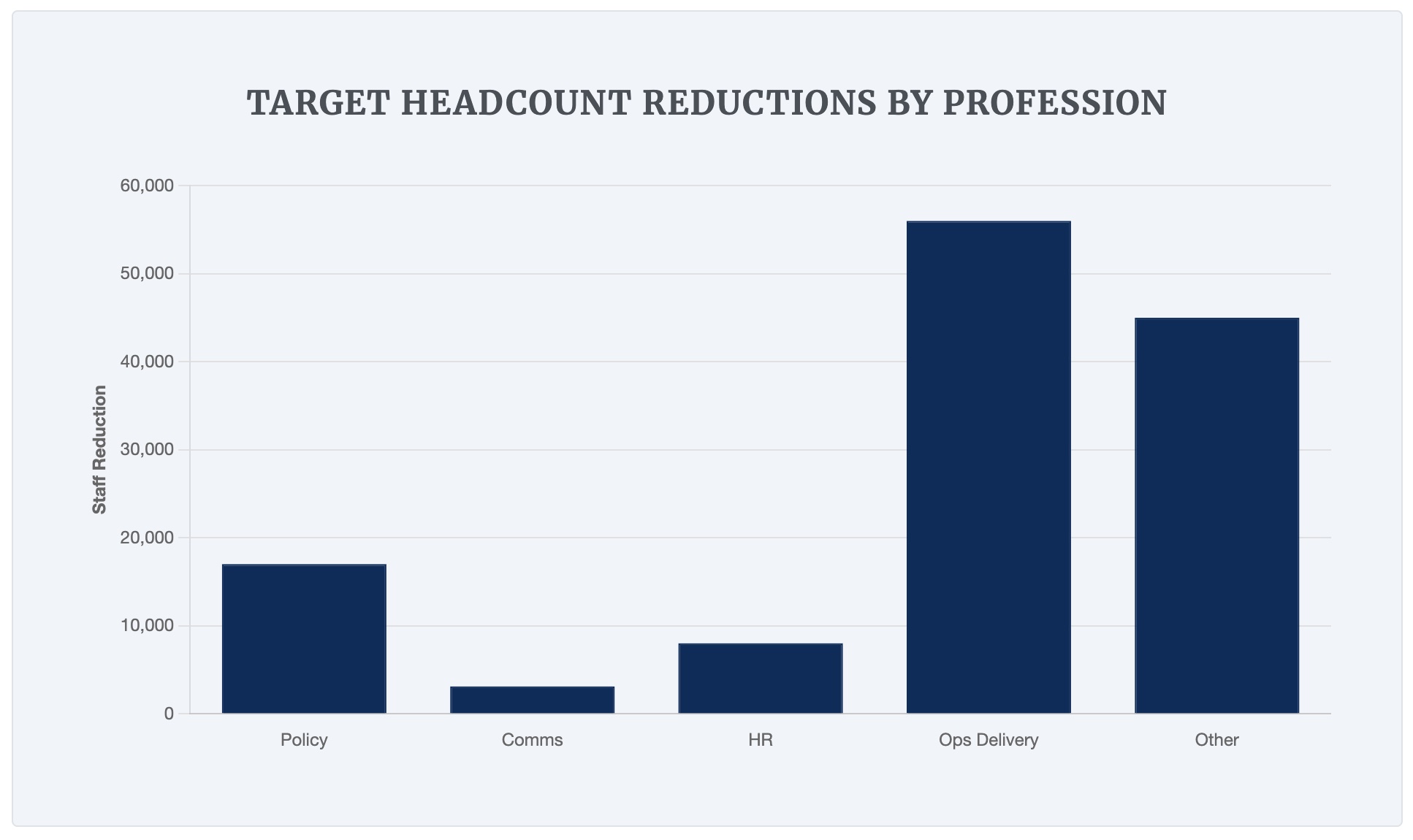
As detailed above, one of the causes of growth in headcount for corporate (i.e. non-operational delivery) functions is the duplication of roles formerly employed in Departments, now matched with people in the Cabinet Office. We will bring forward plans for the reform of the centre of government in due course, but it is noteworthy that while across the private sector in recent years corporate HQs have shrunk, becoming more strategic and data-driven, in Whitehall the centre has grown from 2000 people in the Cabinet Office in 2010 to 10,000 people today.
The process for achieving these reductions will of course be a detailed one. Current terms and conditions, and union agreements on consultation must be respected. But, unlike the current government, we do not expect to make all the reductions through voluntary redundancy and ‘natural wastage’ i.e. not filling roles that fall vacant. We will be deliberate about ensuring that high-performing people who are needed for the organisation are, where possible, retained. We will follow statutory processes but we will not allow these processes to go the way of other efforts at retrenchment in the civil service which simply caused the best people to leave. We will tailor the process to the needs of the government, which are the needs of the public.
Productivity: evidence and experience
As this suggests, we intend to go about government differently from the other parties. And in the same spirit we intend to use the time between now and the next election differently. Rather than working on a manifesto to hand over to the Cabinet Secretary on Day One and ask him or her to work out how to deliver it, we will arrive in government with a fully worked out programme of legislative and executive action.
For this purpose I have invited – and I repeat the invitation now – anyone with expertise or ideas to contribute to our policy process to get in touch. You can do that via this portal. But I also have a very specific appeal to serving civil servants who, like Reform, want to see our government become more efficient and more effective and to serve the public better.
We want to understand the productivity challenge of the civil service from the inside. Work by Re:state, the Effective Governance Forum, Policy Exchange, Fix Britain and others has been invaluable already in this regard.12 But we can do more.
Do you work in the civil service? Tell us about the challenges you face at work. Are you well managed? Underemployed - or overstretched? Do you feel incentivised to succeed? What about your colleagues: are they doing useful work for the country - or not?
We are looking for problems to fix: waste, bureaucracy, political bias, a lack of delivery or accountability, or hierarchies and practices that are stuck in the past.
Talk to us in total confidence - you can submit evidence anonymously, or give us your details so we can get back to you. To fill in our survey please click here.
12 ‘Making the Grade’, Re:state, 2025; ‘Creating a lean heart of government’, Effective Governance Forum, 2025; ‘Smaller, Better, Higher Paid’, Policy Exchange, 2025