Fixing the Centre
Proposals for the heart of Government
By Danny Kruger MP
• 24th May 2026
- Abolish the Cabinet Office and the role of Cabinet Secretary and create a new Office of the Prime Minister under a powerful political Chief of Staff
- Create a new Department of the Civil Service charged with major headcount reduction, AI adoption and improved terms to incentivise high performance
- Restore responsibility for policy and delivery to Departments and make Ministers properly accountable to Parliament
- Give Ministers real powers to hire and fire civil servants, reward high-performing officials and recruit top talent from the private sector
- Scrap quangos and return their powers to government
- Co-locate Ministers in a new Combined Ministerial Office
The Civil Service as such has no constitutional personality or responsibility separate from the duly constituted Government of the day.
Introduction
In my paper of 15 December 2025 (Storm and Sunshine) I explained that Reform UK was reviewing ‘the best way of organising the centre of government to give effect to the wishes of the Prime Minister’. I also invited civil servants to share their experiences, ideas and expertise with us through an anonymous survey. The response has been overwhelming, and I am grateful to everyone who participated and shared their frank and candid assessments.
Today, I am setting out Reform UK’s plans for the centre of government, shaped by the research of the Preparation for Government team, input from leading experts, and our survey of current civil servants. At its heart the proposal seeks to restore the principle set out by Lord Armstrong in 1985. There can be no distinction between the ‘elected’ and the ‘permanent’ government. The Civil Service simply provides staff for politicians to inform and then implement their decisions.
Sadly this is not the view of everyone in the Civil Service today. Last year, in a lecture held at UCL on ‘Bureaucracy and Distrust: The Civil Service in the Constitution’ Dr Ben Yong reflected the views of certain officials working in Whitehall that explicitly contradict the Armstrong principle.
As Yong put it, ‘the Civil Service might have duties to the continuity of the state which are separate from its duty to support incumbent governments’. He suggested ‘the Civil Service has duties not just to the incumbent government but also to something greater: the Crown’. And he discussed that ‘preparation behind the scenes’ could be under way in Whitehall to ensure that in the event of a new government of whom officials disapprove, these ‘duties’ could lead to the Civil Service engaging in ‘guerilla government’, including bureaucratic shirking, leaking and whistleblowing.
This week the Public and Commercial Services Union, representing civil servants, debated a motion to ‘counter a hostile Reform government’ with ‘sustained industrial action’: they are planning to go on strike if we win. (I responded stating that striking on these grounds would be illegal and the civil servants in question would not have jobs to return to.)
It is right that there are checks and balances on the power of the government. We do not have an elective dictatorship. But the proper checks on government are not civil servants, but Parliament and the courts. We want to ensure those institutions are properly empowered to fulfil their roles, without in their turn encroaching on the proper powers of the government. Future papers will look at legislative and judicial reform.
This paper sets out certain proposed changes to the executive, i.e. the apparatus around the Prime Minister and Cabinet: No10, the Cabinet Office, Departments of State, and the Civil Service. Further announcements will be made in due course concerning the Civil Service Code and Ministerial Code.
Our belief is that the current system prevents Ministers, and even the Prime Minister, from getting good quality advice and information; prevents them from implementing decisions effectively; and obscures accountability. Real power is held not by the elected government but by the permanent Civil Service, especially the Cabinet Secretary and the sprawling, incoherent bureaucracy of the Cabinet Office.
The Cabinet Office was set up in 1916 to ensure effective management of the Cabinet itself, enabling collective responsibility and good process. Throughout the 20th century it performed this limited function.
Under Tony Blair and his successors, however, the remit of the Cabinet Office expanded hugely. The Cabinet Office became the principal source of authority, outside HM Treasury, for the rest of government, and the place where all cross-Whitehall functions and priorities were managed. Since 1997 the Cabinet Office has grown nearly fivefold to the point that it now employs over 11,000 staff.
The most telling feature of the current set-up is that 10 Downing Street, the office of the Prime Minister, is categorised in the official organogram of government as a subsidiary unit of the Cabinet Office, listed among The Office for Veterans’ Affairs, the Public Inquiry Response Unit and the Propriety and Constitution Group.
It appears that the people at the top of the Civil Service have seen the weakness of the current Government as an opportunity to extend their power; and are about to go further, under the guise of ‘enhancing trust’. The recent King’s Speech announced ‘proposals [to] strengthen the delivery, accountability, innovation and productivity of the Civil Service. These proposals will also seek to safeguard its impartiality and core values, to enhance trust and confidence in the institutions of government’. This follows the announcement by the new Cabinet Secretary, Dame Antonia Romeo, of far-reaching ‘objectives’ for herself - in which she appointed herself ‘steward for the democratic system of government and guardian of the constitution’. Subsequently the government has announced that ‘every department across Whitehall will be setting up a delivery team led by a top civil servant’; this is either a bizarre replication of the job (‘delivery’) that the Department is already supposed to do, or - more likely - a means by which the Cabinet Office and Cabinet Secretary will extend their control over Whitehall.
It is time to restore the power and authority of the Prime Minister. This paper details the intention of Reform UK to scrap the Cabinet Office, to break up the job of the Cabinet Secretary, and to reintroduce proper responsibility and accountability for Departments of State. These measures will ensure good government for a Reform Prime Minister and all subsequent Prime Ministers. They will also ensure that any action of non-compliance or sabotage by civil servants hostile to the government can be swiftly dealt with.
International comparison
Certainly, Britain is not the only country to have faced challenges with a bloated, paralysed centre of government and a mutinous bureaucracy. Both Australia and Japan use political systems heavily inspired by our Westminster model and experienced similar issues to what we see in Whitehall today. However, they took decisive action a long time ago, ensuring problems could not compound in the way they have for us in Britain.
Australia identified the problems with a ‘dual centre’ of government over half a century ago. They introduced the combined ‘Department of the Prime Minister and Cabinet’ in the 1970s to act as a single, lean authority. With only 1,000 skilled officials, the PM&C put Canberra firmly back under the control of the Prime Minister. More recently, when Australia faced an influx of illegal immigrants very similar to ours, the PM&C was tasked with Operation Sovereign Borders. It quickly created a unified command with the Prime Minister’s authority, and ended illegal boat arrivals within a matter of weeks.
Japan launched radical reforms in 2001 after powerful career civil servants began to run their departments as independent operations, often ignoring the Prime Minister’s agenda and the government’s mandate. The government decisively shifted power from the bureaucracy to the elected executive, eliminating their veto power and reducing the number of departments from 22 to 12. This enabled Japanese leaders to implement vital reforms for the benefit of their country against established institutional interests.
These case studies have helped develop and inform the ideas set out in this paper. There is no reason why Britain cannot implement similar reforms under a government that is properly prepared and is willing to resist attempts by the Civil Service to frustrate them.
Where responsibilities will lie
Under a Reform UK Government the responsibilities will be clear:
No10 (housing the Office of the Prime Minister) will be responsible for setting the Government’s priorities; for coordinating both policy and delivery across government; and for monitoring data to track progress and inform decision-making.
Departments of State will be responsible for developing policy and delivering policy in their respective areas.
A new non-ministerial Department of the Civil Service will be responsible for corporate functions that are not delivered by Departments of State and for transforming the Civil Service as a whole into a smaller, more productive and more capable bureaucracy.
The Cabinet Office will be abolished and be replaced by two new institutions: an Office of the Prime Minister and a Department of the Civil Service. Its policy-making functions will return to Departments.
These changes will allow for the majority of the 11,000+ staff currently employed by the Cabinet Office to be either made redundant or return to specialist functions in Departments.
We are also conscious of the important role of HMT at the centre of government and the need to ensure its work on public spending control does not create damaging levels of micromanagement in other Departments, including in the new OPM and DCS. We will set out further detail on the Treasury’s future role in due course.
The role of the Cabinet Secretary
The post of Cabinet Secretary will be abolished and the role will be split into three distinct jobs.
The role of principal policy adviser and gatekeeper to the PM will be filled by a Chief of Staff, who will be the senior special adviser in government. The Chief of Staff will be appointed personally by the PM, and is likely to be a highly aligned and trusted political staffer who arrives with the PM from opposition.
The role of managing the flow of information and decisions into and out of the Cabinet and Cabinet Committees will be filled by a Chief Secretary, reporting to the Chief of Staff. The Chief Secretary will oversee the combined domestic policy secretariat (see below). This job is also a political one, and it is expected the post holder will be appointed from outside the civil service.
The role of Head of the Civil Service will be filled by the CEO of the Department of the Civil Service. He/she will be responsible for managing the (currently) 550,000-strong Civil Service, and for transforming it into a much smaller and more productive organisation, not least through the adoption of AI. The CEO of DCS is likely to be a business leader with experience of transforming large organisations.
Office of the Prime Minister
“Remove the Cabinet Office. Make No10 powerful again.”
Official, Department for Science, Innovation and Technology
Submission to the Reform UK Civil Servant Survey
The OPM will be led by the PM’s Chief of Staff, who will manage, with full power of appointment and dismissal, all staff working there. Work is under way to prepare the relevant measures to allow the Chief of Staff and select other appointees to exercise these powers.
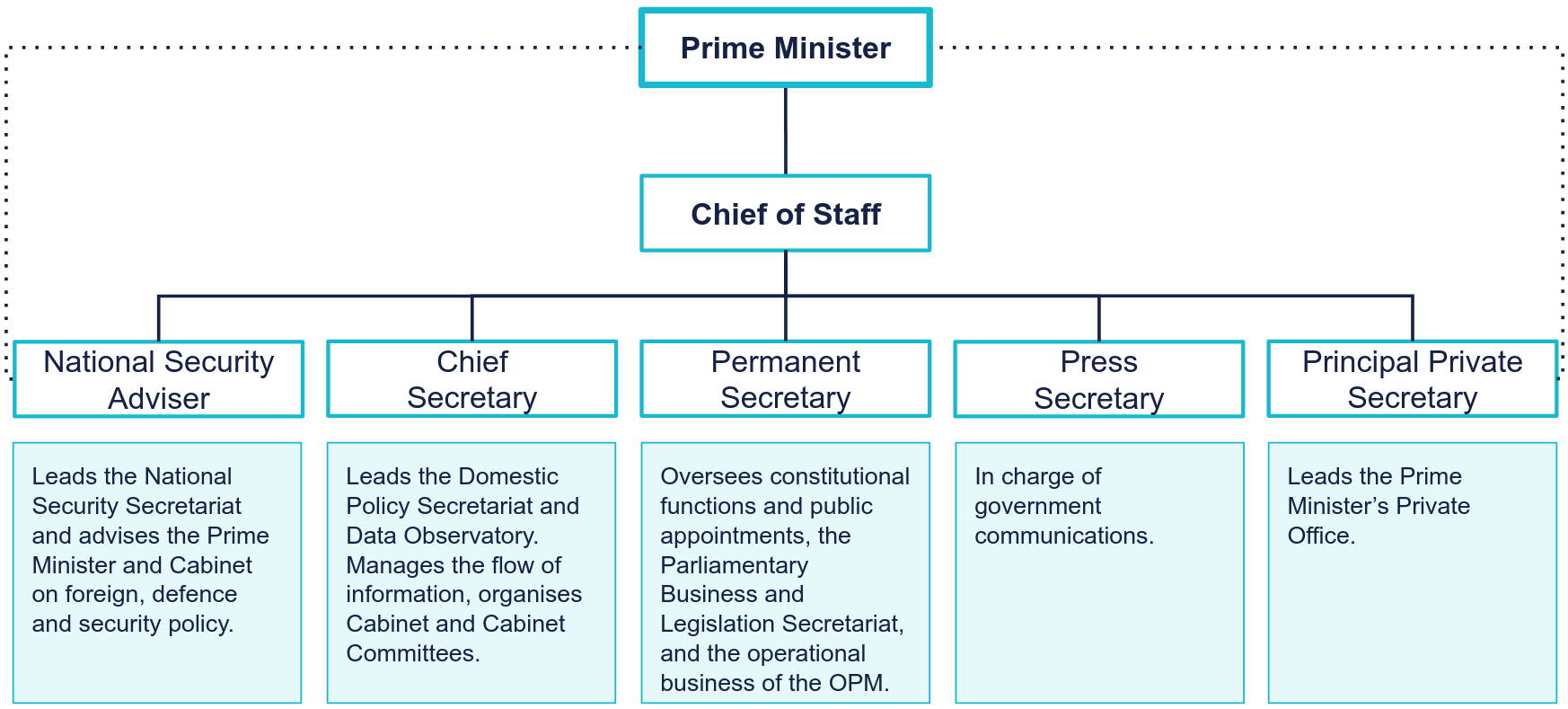
Under the Chief of Staff we expect to appoint the following senior staff.
The National Security Adviser, as currently, will lead the National Security Secretariat and advise the Prime Minister and Cabinet on foreign, defence and security policy. Further work is underway to plan reforms to the processes for managing national security and civil contingencies.
The Chief Secretary will lead a Domestic Policy Secretariat to support the Prime Minister, Cabinet and Cabinet Committees on all economic, social, constitutional and cultural policy, incorporating the work of the current Economic and Domestic Affairs Secretariat. Secretariat staff will be a combination of special advisers and civil servants. The team will include a high-functioning data centre or ‘observatory’ capable of tracking progress in the Government’s priorities and developments across any aspect of national life. This would build on the current National Situation Centre used by the National Security Secretariat, including the Resilience Directorate and the COBR Unit. The OPM will design standards for reporting and analysis across Whitehall and conduct regular stocktakes on key policies and priorities. Where necessary, the OPM will be able to deploy specialist project teams to work closely with responsible Departments where specific projects are at risk, identifying and resolving barriers to delivery - especially where this requires action from other Departments.
The Permanent Secretary at the OPM will oversee the managerial and constitutional functions of 10 Downing Street, including honours and appointments, relations with HM The King, and the Parliamentary Business and Legislation Secretariat. The OPM Permanent Secretary will be a career civil servant, though not necessarily recruited from the current Permanent Secretary cadre.
The Press Secretary or Communications Director at the OPM will oversee all government communications.
The Principal Private Secretary to the Prime Minister, as currently, will lead the Private Office and support the PM directly.
Departments of State
“[The] NHS doesn’t speak to DWP doesn’t speak to HMRC doesn’t speak to Insolvency Service doesn’t speak to Police and so on. Departments cannot [share data], many are legally prevented from doing so, and the net result is that we lose billions in fraud and error year on year [...]”
Official, Government Agency
Submission to the Reform UK Civil Servant Survey
The core principle of Reform’s preparation for government is the restoration of Ministerial accountability for the actions of the state. This accountability demands real responsibility. Responsibility starts at the top, with the centre of government being equipped in the ways explained above to properly drive the Prime Minister’s agenda through government.
Accountability and responsibility apply equally at the Departmental level. A stronger, more agile centre, focused on prioritising, coordinating and monitoring government activity, depends on much stronger Departments responsible for the actual design and delivery of policy.
Under Nigel Farage’s premiership, Secretaries of State will know what they are supposed to do. Ministers will enter their Departments on day one of a Reform government with a clear programme of action and clear expectations for delivery.
The ‘machinery of government’ - what Departments are needed, and which Departments do what - matters, and we will come forward with a planned structure of Whitehall in due course. More important than structures, however, is the quality and the culture of the people who occupy them. Any ‘MoG’ changes we will bring forward will be designed to improve this.
Since the 1990s Departments have had their own delegated powers to hire their own people and manage their own functions. Delegation has the benefit of avoiding whole-of-government equal pay claims; it has also had the downside of being uneven and duplicative, which is why Francis Maude, working for David Cameron, introduced so many central functions at the Cabinet Office.
More importantly, however, delegation means that Departments, if they wish, are able to innovate with staffing and operations; it means that Departments, if the government wishes, are responsible for what they do. This is the right principle.
The principle is not upheld at present. Since 1997 strategic policy has been centralised in the Cabinet Office, while tactical policy, and the delivery of it, have been outsourced to quangos. The result, to put it bluntly, is that Departments are frequently very poor at both policy and delivery.
Quangos are not only captured by lobby groups in the sectors they oversee, and unaccountable to Ministers and the public. As stand-alone regulators or agencies, each solely focused on their particular individual responsibility, they issue absolute edicts designed to protect or promote their singular priority. Natural England, notoriously, has no remit to consider the impact of its environmental regulations on the supply of housing or jobs. And yet voters will, quite rightly, reward or punish the government ‘in the round’, not least for the way it manages the trade-offs involved in any particular decision. Managing trade-offs is the business of politics, and we need more politics, not less.
Under a Reform UK government the great majority of quangos and agencies will be brought back into the Departments, or scrapped. This will bring the real experts into government; make them meaningfully accountable to Ministers and thus to Parliament and the public; and ensure their issue-specific advice is considered alongside other, competing priorities.
The abolition of the Cabinet Office, the establishment of the Office of the Prime Minister and the restoration of responsibility and accountability to Departments create the opportunity to establish stand-alone teams tasked with innovating outside ‘business as usual’ operations.
A team or taskforce could work with OPM colleagues, similar to how cross-government units work today but directly reporting to a Minister, to develop bespoke solutions to sudden crises; to fix long-running dysfunctions that the ‘business as usual’ team can’t spare the time, or lacks the expertise, to deal with; or even to establish parallel, probably highly digital, operations in certain functions to demonstrate a better way of working than the analogue operation of the status quo.
Departmental leadership
Each Department will be headed by the Secretary of State who would appoint a Chief of Staff and a Permanent Secretary with the approval of the Prime Minister.
Whereas the job of the OPM will be focused on setting the government’s priorities and ensuring the smooth flow of information and the communication of decisions among the Prime Minister, Cabinet and Cabinet Committees, Departments of State are responsible for policy design and, crucially, delivery - including in some cases the delivery of large and critical state functions and public services.
While it is expected that the OPM Permanent Secretary will be a senior civil servant with experience in Whitehall, it is likely that a significant number of other Permanent Secretaries will be appointed from outside the Civil Service. We are looking for proven leaders with a track record of effective delivery and the interplay of strategy, analysis and operations.
Permanent Secretaries will be expected to work closely with the CEO of the Department of the Civil Service, who will certainly be a proven business leader, to deliver the changes we expect to make in Whitehall, including in headcount, AI adoption, and ways of working.
Staffing
“The fact that no one gets sacked creates a sense of entitlement in staff; as though the departments exist for their benefit. Consequently, many colleagues don’t do any work [...] The ability to sack people for poor performance would solve this.”
Official, HM Revenue & Customs
Submission to the Reform UK Civil Servant Survey
It is essential that Ministers, who are responsible to the Prime Minister and to Parliament for the work of their Departments, have the power to choose the officials who advise them and execute their decisions. In addition, as set out above, we also want select officials such as the OPM Chief of Staff to have full control over staffing.
Crucially, under a Reform government the Secretary of State will have the power to appoint or dismiss the Permanent Secretary of his or her Department. The Permanent Secretary will direct the staff of the Department but the principle should be clearly established that Ministers can request the appointment or dismissal of particular officials. Private Offices, in particular, should be entirely appointed by Ministers.
We are working through the legal implications of these proposals. We expect to replace the Constitutional Reform and Governance (CRAG) Act 2010 in order to grant Secretaries of State and select officials these powers. We also want to remove statutory barriers to direct appointments into the most senior leadership tiers (SCS3 and above).
To support the work of Ministers and the Chief of Staff, there will be a significant increase in the number of Special Advisers. Rather than aspiring young politicians, it is expected that most SpAds will be experienced either in the work of the specific Department or in the challenges of analysis and operational delivery.
Overall, there will be major reductions in the headcount of Whitehall. As described in Restoring Government and Storm and Sunshine, we are confident of cutting non-operations professions like policy, comms and HR by at least 50%. Different operational functions - prison officers, for instance, or Border Force - may require additional staff depending on our manifesto commitments. But overall, we expect significant reductions at all levels of government, not least through the enormous transformation that AI is bringing to clerical and analytic work.
More important than overall numbers is the skills and type of worker in the Civil Service. The current system consists of relatively low pay, low accountability, high job security and high predictability of earnings, including a general defined benefit (DB) pension. This does not attract or retain the type of people the government needs.
Reform UK will introduce radical change to Whitehall remuneration packages. We will explore options for modernised terms for new hires that offer more generous salaries, with a greater performance-related element, at the expense of more modest pensions.
As set out in December, we will offer major performance bonuses, to Departments, teams and individuals. And we will establish prizes, with a significant financial value, to civil servants who crack specific policy, analysis or delivery challenges. (The Government has subsequently announced a limited version of this approach, but one that misses the mark - they will pay limited bonuses only to the highest earning, most senior civil servants. Their teams, those who actually deliver the work, get nothing. This is not Reform’s approach. With us, any official, starting from the most junior grade, can qualify for substantial bonuses.)
Crucially, we will also change the system to allow for pay rises within a single post, subject to high performance, so that an official does not, as they currently do, need to apply for a promotion to a different job - often in a different Department - just to secure a better salary.
These changes will help address the chronic condition of the Civil Service, namely too much ‘role-level’ turnover and not enough ‘organisation-level’ turnover. People constantly change jobs within the Civil Service but too few people come and go to and from the Civil Service itself.
Scrapping the Cabinet Office means losing central coordination of the Civil Service Fast Stream, which the Cabinet Office administers. This is a good thing. While we might retain the Fast Stream brand, Departments should manage their own recruitment schemes, competing for talent and developing strong career pathways for specialists in their field.
A more endemic challenge is the split between ‘policy’, ‘analyst’ and ‘operational’ roles. In an echo of the old ‘Two Cultures’ identified by CP Snow - the split between humanities and science in the British establishment - we have a high-status class of ‘policy’ professionals, usually trained in the humanities and termed ‘generalist’ because of their lack of actual domain knowledge, and two low-status categories of a) analysts who provide the statistical annexes to the submissions written by the policy professionals, and b) operational staff who work somewhere else and deliver the policy on the ground.
We will significantly cut the ‘policy profession’, which has more than doubled in the last 10 years, without any noticeable improvement in policy-making. A key requirement of people advising Ministers on policy in a Reform government will be analytical and project-management (i.e. delivery) skills. The people informing policy decisions should be those who understand - both analytically and empirically - the thing they are talking about. We will always need expert analysts to build complex models and supply detailed interpretation of data; and we will need people whose core job is operational delivery. But we do not need the current large number of ‘policy professionals’ with few quantitative skills and limited understanding of what it takes to execute policy on the ground.
All these changes are designed to induce a new culture - not of risk aversion (no prizes for success, extreme organisational inertia) but a healthy entrepreneurialism, with a more realistic and ambitious appetite for risk.
Co-location of Ministers
“Everything is siloed and [consequently] causing turf wars.”
Official, HM Treasury
Submission to the Reform UK Civil Servant Survey
As outlined above, we intend to return to Departments many of the responsibilities currently exercised by the Cabinet Office, by quangos and external agencies. As this suggests, what is needed is more, not less, ‘politics’, in the sense of a publicly-accountable process of accommodation, compromise and decision-making among competing imperatives.
The same principle applies at the top. A system of more powerful - autonomous and responsible - Departments creates a centrifugal risk, i.e. Ministers pursuing independent lines without proper coordination. This already accounts for the ‘Departmental capture’ that afflicts many Ministers: working all day in their offices, surrounded by officials who assist them to promote the particular line of the team.
Countervailing ‘centripetal’ remedies are needed to balance the empowerment of Departments. One is the reforms to the centre detailed above, which are designed to ensure better prioritisation, coordination and monitoring of government policy. We need to reinforce this by bringing Ministers themselves into the centre.
A Reform Government will ensure that Ministers from across Government Departments can work together in the same space for some of their working week. A Combined Ministerial Office will be established in a central venue - perhaps 70 Whitehall, the Foreign Office, or Government Offices Great George Street (GOGGS) - to enable co-location of Ministers and effective collaboration, including through Cabinet Committees and project working groups.
Importantly - to avoid the emergence of a new Cabinet Office, with all the problems of the current one - the CMO will not employ civil servants. It is purely for Ministers, supported by the OPM.
Department of the Civil Service
“[It is] impossible to bring in obviously talented people who can do the job without months of HR [trouble].”
Official, Department for Energy Security and Net Zero
Submission to the Reform UK Civil Servant Survey
The growth of Cabinet Office numbers is partly due to the way the centre mirrors Departments, matching their functions with its own duplicate teams of officials.
Under a Reform government most responsibilities, including the crucial jobs of general recruitment and HR, will be fully entrusted to Departments. As set out above, the Cabinet Office-led Fast Stream will be replaced by Department-level recruitment schemes.
However, there is an important role for the centre with respect to senior recruitment. The Government People Group currently employs around 12,000 people, against a Civil Service headcount of 550,000 - a ratio of 0.02:1 HR professionals per employee, double the ratio of large private sector organisations. This team will be radically slimmed down and entirely repurposed, away from HR - the management of staff, which is properly a Departmental responsibility - and towards elite talent acquisition. It will sit in the DCS and be a top priority for the CEO.
Its job will be to find the best people from outside government to serve the Crown. It will ensure more domain-expert recruitment and develop more innovative approaches to pay.
The DCS will also develop training programmes for senior civil servants, and possibly partner with a leading university to establish a campus, similar to the Defence Academy at Shrivenham, to help senior officials develop the skills they need for leadership. Meanwhile, Labour’s plan for a state-run ‘school of government’ is a backwards step, creating an expensive echo chamber where the Civil Service trains and evaluates itself and which is lacking the external disruption and input that is urgently needed.
The other key function of DCS will be improvement of procurement across Whitehall. As with HR, procurement properly belongs with Departments. We need more domain-expertise and commercial savvy in procurement teams - to avoid being ‘end-run’ in contract negotiations by highly expert suppliers - and we need more flexibility and innovation to ensure that the government buys goods and services that deliver real value as fast as it is needed.
The danger of a delegated and flexible approach, however, is anomalous or even corrupt practice by procurement teams. The DCS will include a ‘procurement hit squad’ empowered to constantly review contract decisions by Departments, to share learning, improve quality and identify possible corruption. It is expected that the CEO and leader of this function in the DCS will be held closely to account by the Public Accounts Committee of the House of Commons.
A Reform government would take the development of the Civil Service seriously. While we will need to scramble a large number of experts and allies to assist with the ‘emergency reset’ of Britain immediately after the general election, our aim is to build a better state for the long-term. The benefits of a high-performing DCS will not be felt for some years. We need to make the state fit for the crises which we cannot predict, but which are coming.
To this end, Reform is actively looking now for the future leader of the DCS. It is certain this individual will be a non-civil servant. They may have some experience of government, but this is not necessary. What is necessary is extensive experience turning around large organisations, delivering major headcount reductions and improvements in the quality and productivity of the team. If this is you, please get in touch.